UX design · Hackathon
Designing an AR navigation tool for delivery partners
Overview
TL;DR
- Event
- Clan Design Community hackathon
- Year
- January 2025 · 6 hours + 1 week
- Role
- Team lead and product designer
- Team
- 4 designers
At the Clan Design Community hackathon, our team was asked to design an app that makes life easier for delivery partners. We focused on one moment that often goes wrong: finding the right door inside a gated society.
I led the team and designed the product, an AR navigation tool built into Swiggy that guides partners from the gate to the door. After the event, I spent a week turning our rough wireframes into the final designs.
The brief
Help delivery partners in their daily work
The brief was open: “Design an app which helps the lives of delivery partners.” It left the choice of problem to each team.
Constraints
Time
6 hours (from brief to presenting solution)
Fully offline
The hackathon was fully offline. With no phones or internet, we couldn’t do research online, so we ideated purely from our experiences.
Refined problem statement
How might we help delivery partners find the right house inside a gated society
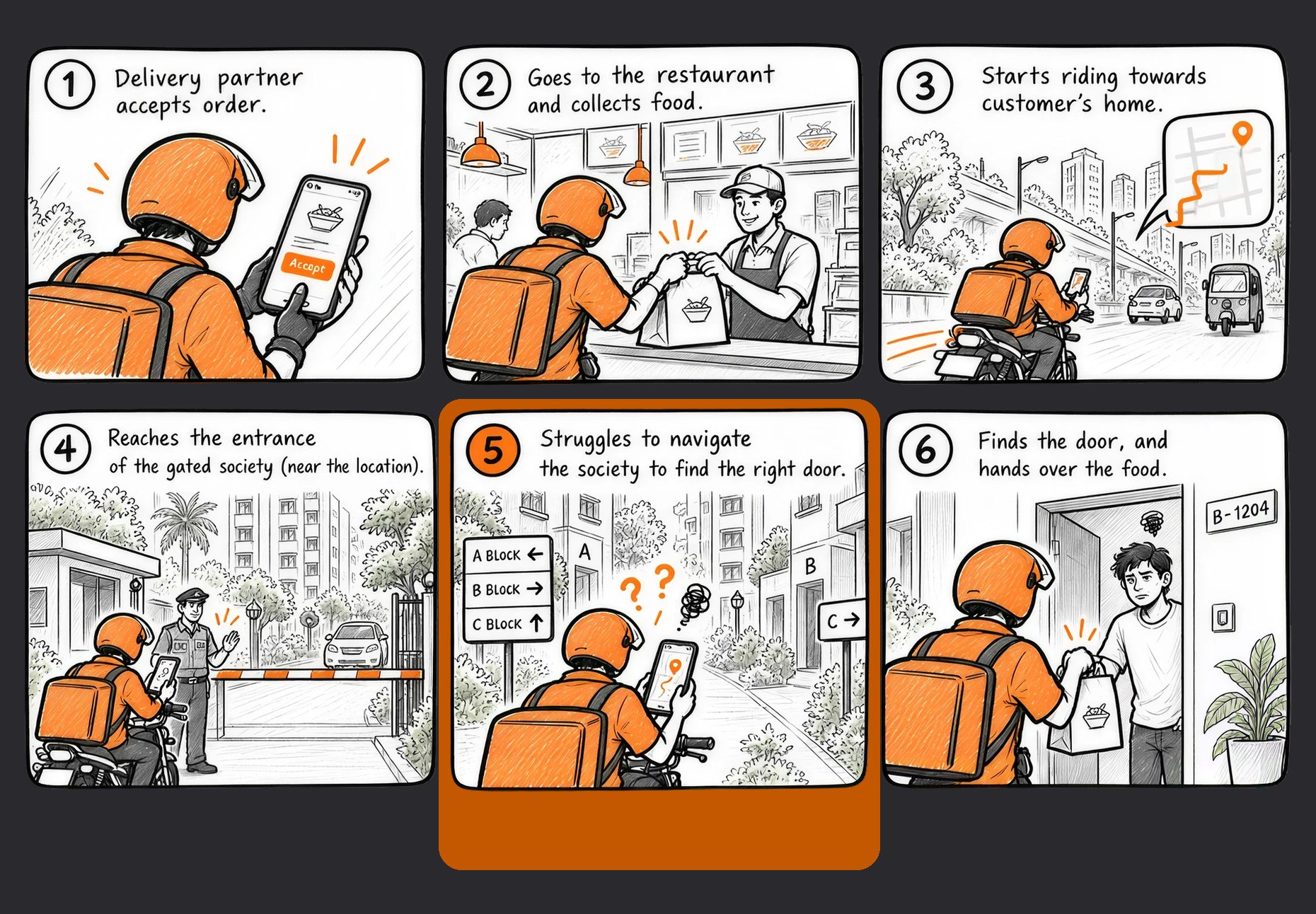
While brainstorming and laying out the entire journey of a delivery partner end to end, I realized (from my own personal experience and validation with the other people in the room) that drivers usually have a frustrating experience in finding the right door when the delivery is inside a gated society.
The problems delivery partners face inside the society
The map apps can guide partners to the gate, but once inside, they offer little help finding the right door.
Several hassles stack up once a partner is inside: confusing layouts, unclear signage, multiple entry points, customers who don’t answer the phone, and language barriers with security.
It causes confusion, late deliveries, and frustrated customers.
Why this problem is worth solving
- Quick e-commerce services promise orders in 10 to 15 minutes.
- Customers have come to expect their food within that time.
- Business gets hurt by late deliveries.
The challenge
How might we make it easier for delivery partners to navigate the maze of gated societies and find the right house fast?
Solution
Precise navigation for small premises
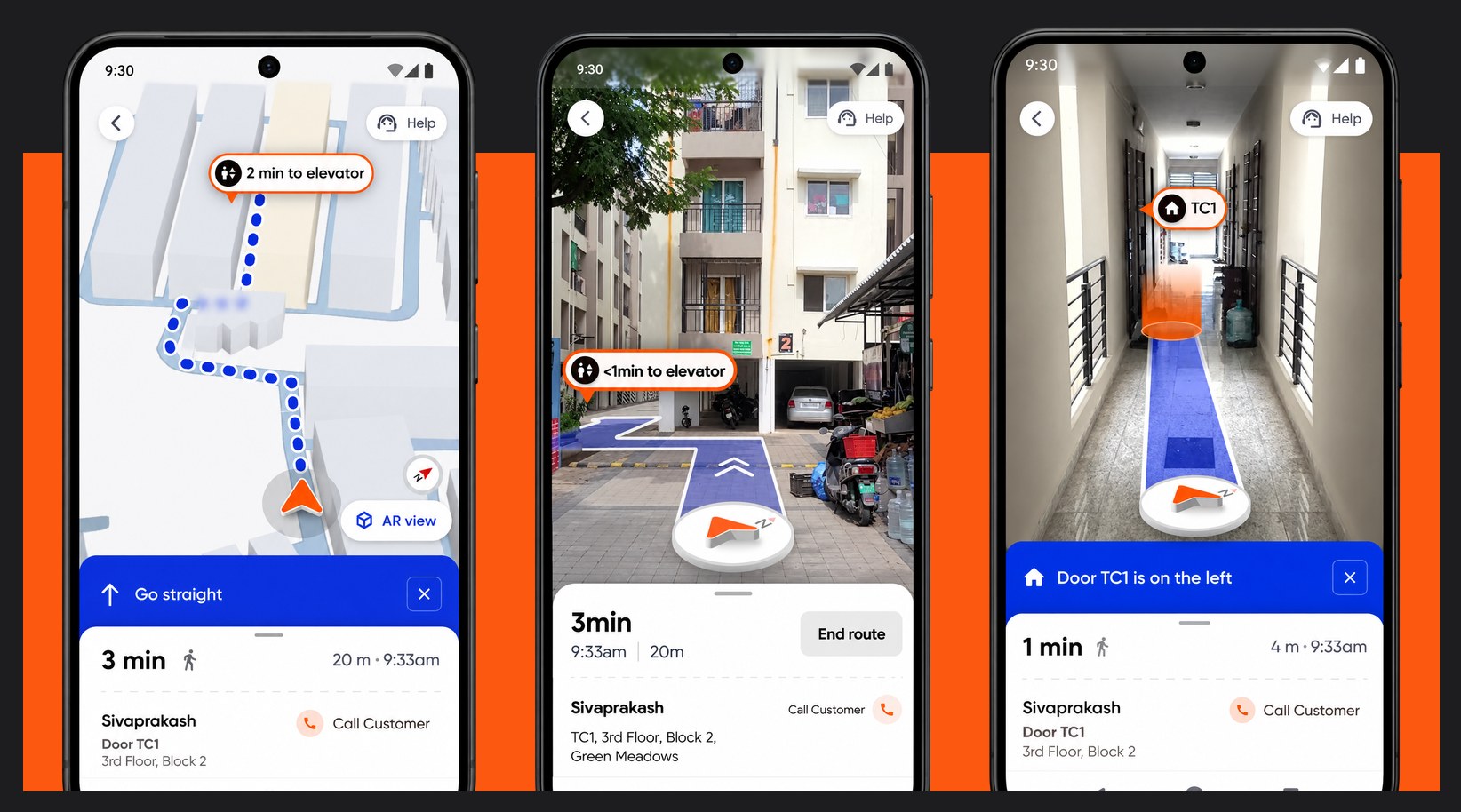
We ideated a highly accurate navigation tool for small premises, in this case a gated society. It has two parts:
- Integration with existing delivery apps, so it works inside the apps partners already use.
- AR navigation that makes the last stretch easy to follow.
The impact we expect
As a way to measure success, these were our expectations:
Business goals
- Faster deliveries help partners complete more orders.
- The same tool can scale to other places to expand business, such as airports, college campuses and supermarkets.
For partners and customers
- Less confusion for delivery partners.
- Happier customers.
Integration
Building it into an existing delivery app
We built the tool into an existing delivery app, using Swiggy as our example.
- Upon reaching the gate, Swiggy prompts the driver to check the route
- “Find route” opens the tool.
- They follow the 3D map of the society to the elevator.
The flow
Guiding the partner from the gate to the door via AR
The route moves from a map to the camera as the partner gets closer.
- Switch to AR, with the path drawn on the ground and turns given by landmark.
- Take the elevator to the right floor.
- Find the door, marked with a tag in the corridor.
- Complete the delivery on the “Arrived” screen.
Where the idea came from
Video games use a quest marker to guide players straight to where they need to go. We borrowed that idea for the last stretch of a delivery.
Retrospective
Winning first place at the hackathon
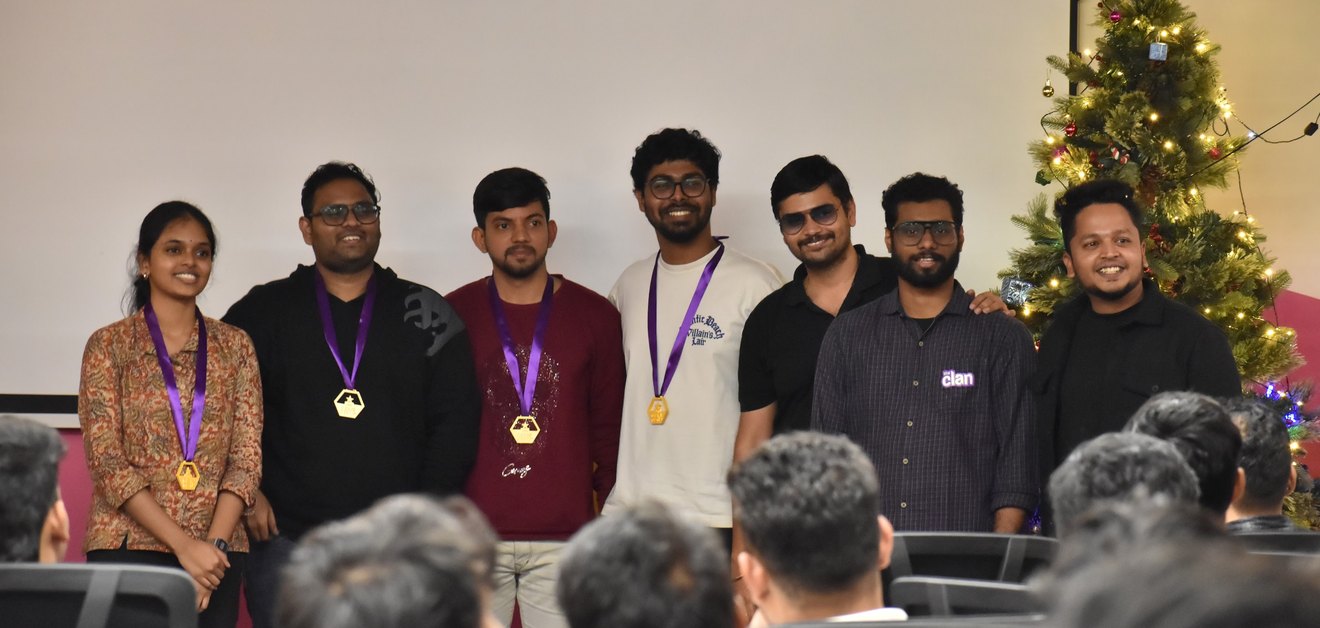
Our team winning first place at the hackathon was definitely one of the core moments in my design career because it was not only well received by Ramkumar, the mentor who guided our team but it also gave us overwhelmingly positive validation from Shyam Krishnan and Shai Krishna, who were the judges and also few of the most sought-after designers in India!
Takeaway
Stick to one use case and one user, and go deep.
With only 6 hours, we picked one moment, the last stretch to the door, and one user, the delivery partner, and designed for that alone. That strategy helped us get more time sketching out the screens and presenting it to the judges.